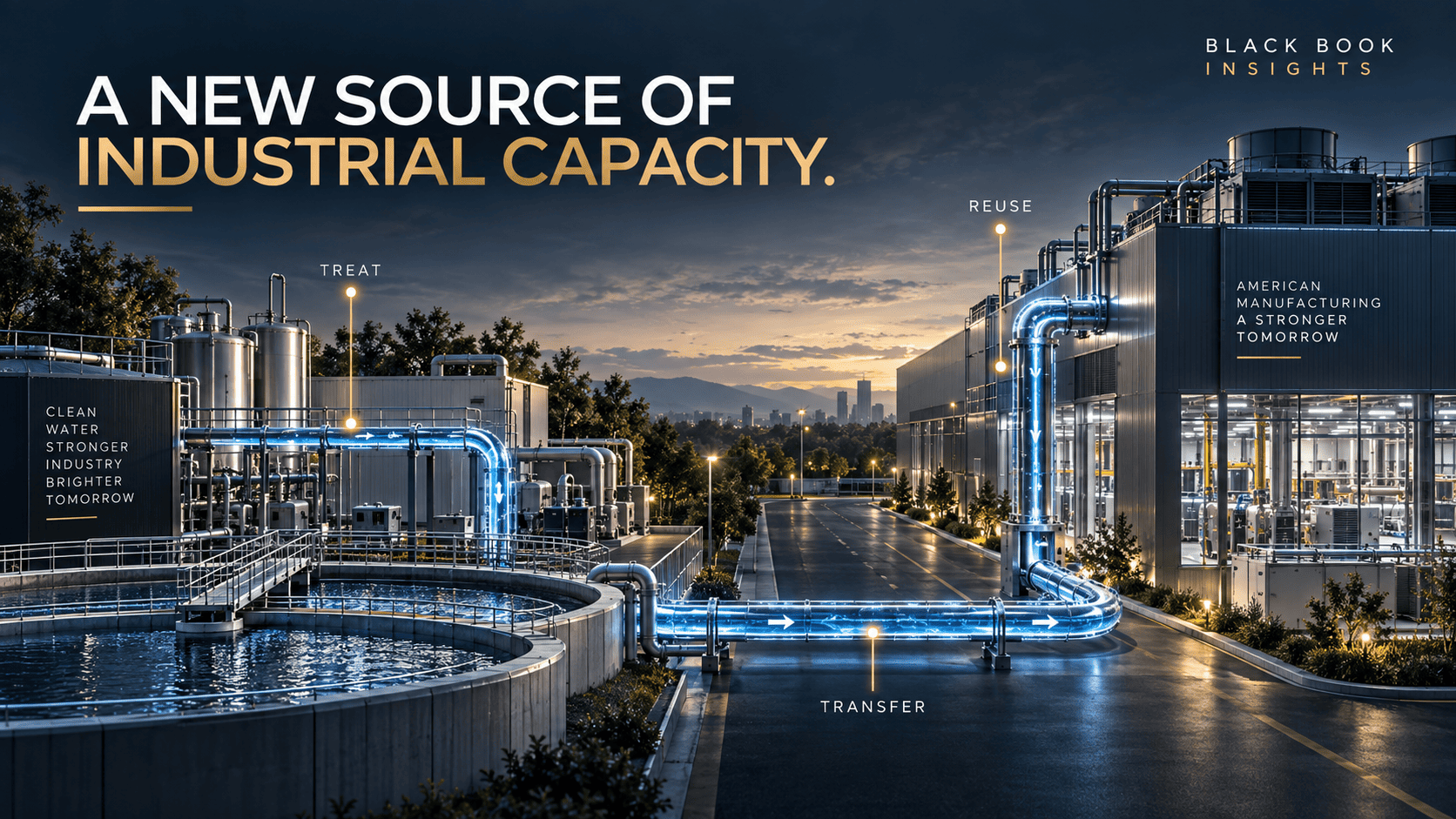
Industrial water reuse deserves a place in site selection and capital planning. For the right project, treated water is not merely a sustainability measure—it is part of the production strategy.
Before a manufacturer asks a community how much freshwater it can supply, it should ask a second question: what water is already being treated, discharged, or circulated nearby, and could any of it safely support the proposed operation?
That question belongs near the beginning of a reshoring project.
In April 2026, the Environmental Protection Agency launched Water Reuse Action Plan 2.0, placing greater emphasis on reuse for domestic industry, technology, and energy. The initiative includes work on food and beverage production, industrial cooling, and tools to identify alternative water sources.
The significance is not that every factory should use reclaimed water. It is that reshoring teams now have an explicit industrial-policy reason to evaluate it.
September brings the discussion closer to the factory floor
EPA’s September update highlights a $12 million National Alliance for Water Innovation solicitation targeting onsite industrial water reuse. The identified water sources include cooling water, process and rinse water, and wastewater-treatment effluent. The concept-paper deadline was September 15, 2026; full proposals are due November 24 for applicants meeting the submission requirements.
These are development and demonstration opportunities, not evidence that every proposed system is ready for commercial deployment. Nevertheless, they identify practical industrial streams around which manufacturers can organize an assessment.
EPA also lists a September 23 Department of Energy webinar on mapping a path toward industrial water reuse. The broader series addresses fundamentals, implementation, and financing.
For manufacturers building 2027 capital plans, September is therefore a useful moment to move water reuse from a general environmental discussion into project-level evaluation.
Start with the required use, not the available technology
The first question should be what quality and reliability of water each operation actually requires.
A proposal should distinguish cooling, cleaning, rinsing, process use, and other applications rather than treating the entire facility as one water demand. It should then identify the treatment and monitoring necessary for the specific intended use.
Regulatory permission must be checked locally. EPA’s industrial resources explain that states differ in the industrial applications they permit and provide access to summaries covering authorized uses, water-quality specifications, and treatment requirements.
Black Book recommends a joint assessment by plant engineering, quality, environmental management, the relevant utility, and permitting specialists before assigning financial value to a reuse opportunity.
The right conclusion may be a relatively straightforward cooling application. It may be an onsite recovery system. It may also be that reuse is not justified for the proposed process.
The objective is a better production decision—not the highest possible recycling percentage.
Price the connection, not just the water
A nearby wastewater-treatment plant does not automatically mean an economical industrial water supply.
The business case should account for conveyance, additional treatment, storage, pumping, monitoring, maintenance, residuals management, backup supply, and the cost of operating the system at the required reliability.
Black Book recommends comparing complete operating scenarios rather than comparing the price of freshwater with an assumed low price for reclaimed water.
One scenario might emphasize purchased supply. Another might combine external reclaimed water with onsite recovery. A third might reduce overall water demand through process changes.
Each should be tested against the same production schedule and contingency requirements.
The analysis should also examine expansion. A water arrangement sufficient for the first production line may not support the second. A project should not claim long-term capacity advantages without establishing how additional demand would be served.
Communities can compete on a better offer
Economic-development teams should consider whether water planning can strengthen their industrial proposition.
Instead of offering only land and incentives, a community could help prospective manufacturers understand available water sources, permitted uses, infrastructure responsibilities, and realistic development schedules.
That does not mean shifting industrial costs onto residents. Black Book recommends that any proposed partnership explicitly address who pays for the infrastructure, who maintains it, what happens during an interruption, and how existing community and environmental commitments remain protected.
The potential advantage is a more credible site package—not a promise of unlimited water.
For smaller manufacturers, regional collaboration may also be worth evaluating. Shared infrastructure should be considered where technically and commercially appropriate, but only after demand, operating responsibility, and cost allocation are defined.
Black Book’s position: water reuse belongs in the reshoring business case wherever it could materially affect production reliability, site suitability, or expansion capacity.
A wastewater plant will not appear in every manufacturer’s supplier directory. For some projects, it should.