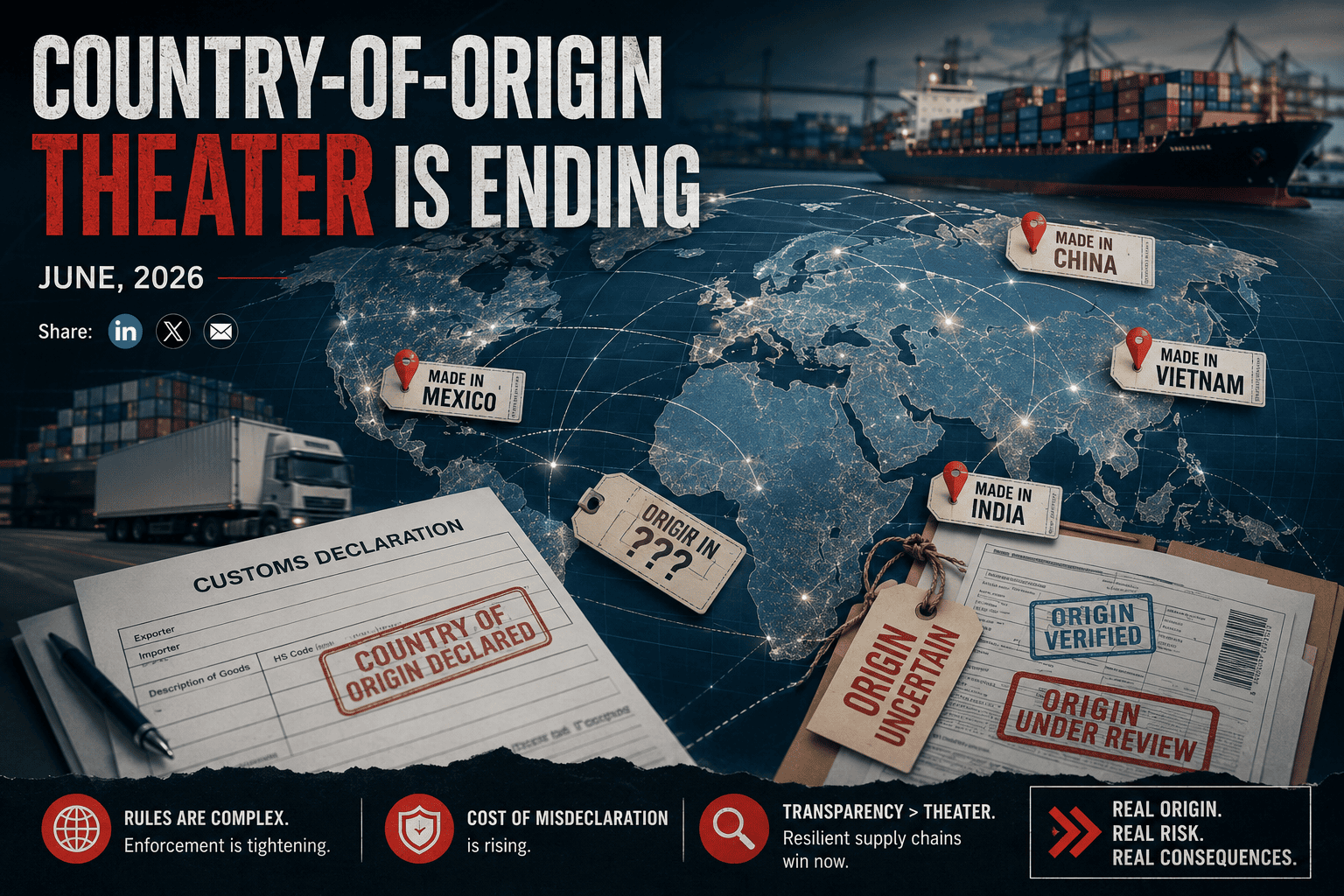
For years, some companies treated country of origin as a documentation exercise.
That era is ending.
Tariffs, forced-labor enforcement, USMCA review, and rules-of-origin scrutiny are turning origin claims into board-level risk. Companies that rely on vague supplier attestations, incomplete bills of material, or superficial “substantial transformation” narratives are moving into dangerous territory.
The Trump administration’s 2026 trade posture is accelerating this shift. USTR launched Section 301 forced-labor investigations across 60 economies, covering more than 99% of U.S. imports by 2024 value. The focus is not only whether forced labor exists somewhere in a supply chain. It is whether trading partners are failing to impose or enforce effective import restrictions.
That is a major compliance signal.
USMCA review adds another layer. U.S., Mexican, and Canadian negotiators began the 2026 joint review with stated goals that include reducing dependence on non-region imports, strengthening rules of origin, and enhancing North American supply-chain security.
The implication is clear: North American content claims will matter more, not less.
This creates a problem for companies that have used routing, light assembly, repackaging, or limited processing to manage trade exposure without truly changing supply-chain economics. As tariff pressure rises, the incentive to relabel supply chains rises with it. So does enforcement risk.
The next compliance frontier is not only customs classification. It is traceability.
Companies will need better documentation of component origin, supplier ownership, labor exposure, transformation steps, regional value content, and tariff treatment. Procurement, legal, tax, logistics, and operations teams will need to work from the same data set.
Country-of-origin theater worked when scrutiny was lower and supply-chain maps were opaque. In the 2026 environment, opacity is not a strategy. It is an exposure.