The reshoring debate is still too focused on labor.
Labor matters. Automation matters. Incentives matter. Tariffs matter. But for a growing number of industrial projects, the first gating question is simpler: can the site get enough power?
Power availability is becoming a core reshoring constraint. Not a utility footnote. Not a late-stage permitting issue. A front-end site-selection variable.
Black Book Insights’ May 2026 reshoring analysis identified power, permitting, labor, and automation as major bottlenecks. That list should now be read as a warning. The United States can announce industrial policy faster than it can build substations, transmission capacity, interconnection queues, water systems, and skilled maintenance labor.
The pressure is rising because reshoring is not happening in isolation. Semiconductor fabs, battery plants, aluminum facilities, chemical operations, data centers, AI infrastructure, cold storage, and advanced manufacturing all compete for power-intensive sites. Deloitte’s 2026 manufacturing outlook points to the continuing role of manufacturing investment, data centers, semiconductors, smart manufacturing, and AI in shaping the industrial landscape.
That convergence changes the economics of reshoring.
A site with cheap land but weak power access may be less attractive than a more expensive site with faster interconnection, stronger utility coordination, and clearer permitting. A state incentive package that ignores power timing may be worth less than advertised. A reshoring project that assumes electricity will appear on schedule is not a plan. It is a dependency.
This is especially important for companies trying to compress timelines. Tariffs can change in months. Board pressure can change in quarters. Power infrastructure often moves on a different clock.
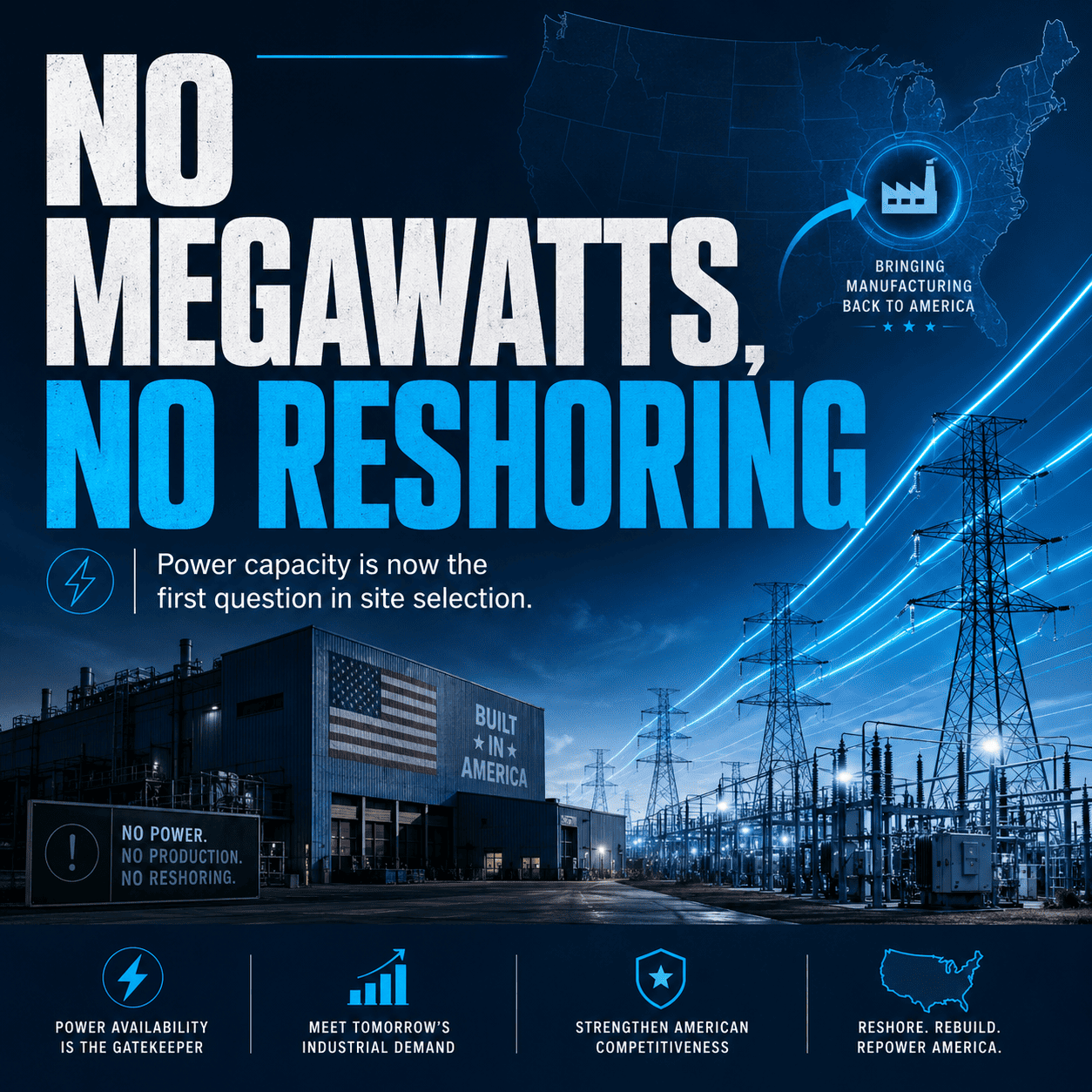
The provocative conclusion is blunt: no megawatts, no reshoring.
Companies evaluating U.S. manufacturing moves should put power availability beside labor, incentives, freight, suppliers, and customers from the beginning. Communities competing for projects should do the same.
Industrial strategy is now energy strategy.