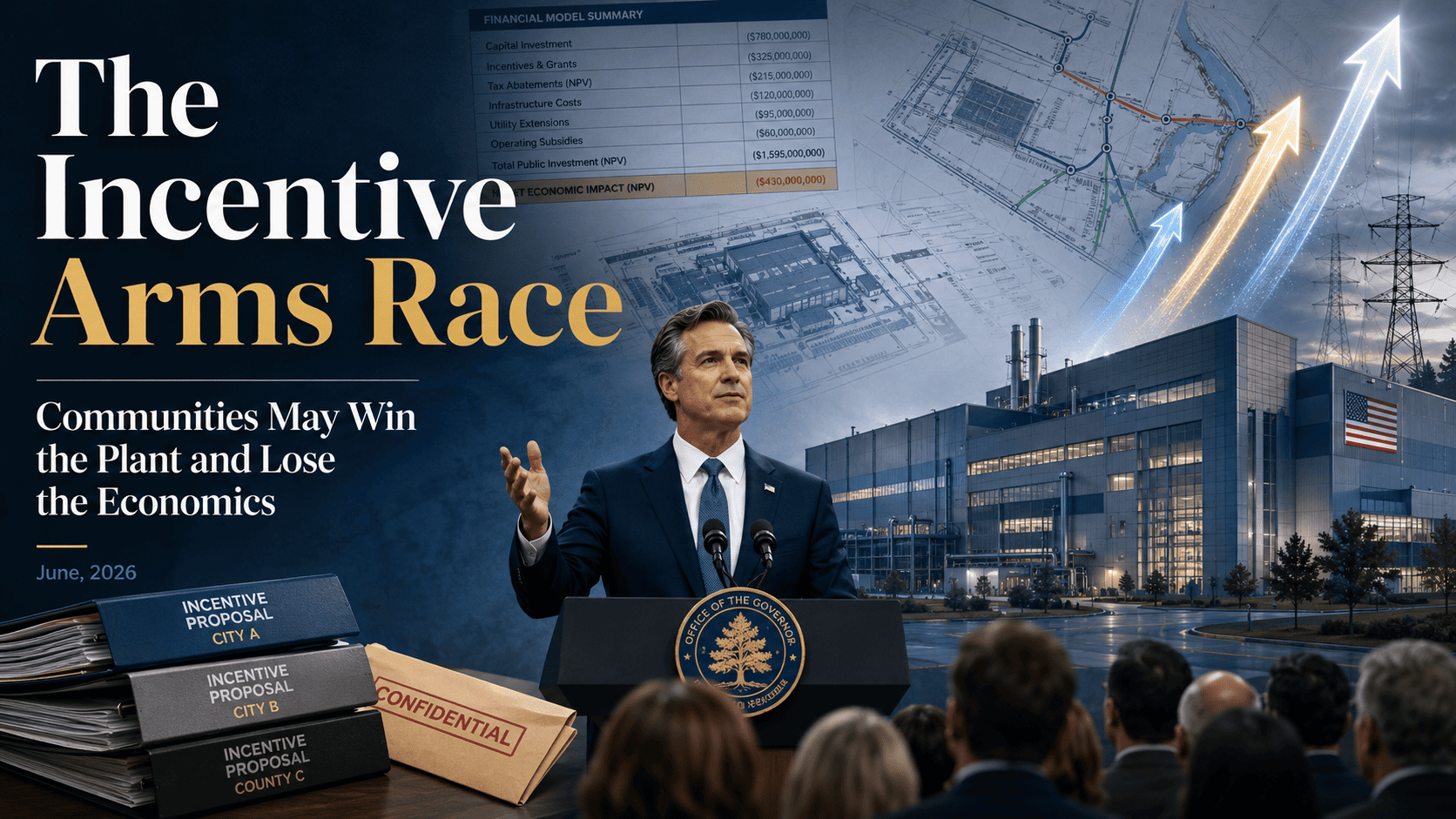
The next reshoring boom could produce a familiar mistake: communities competing aggressively for projects without fully pricing the cost of winning.
State and local incentives matter. KPMG’s 2026 tariff survey found that nearly half of respondents said state and local incentives strongly influence reshoring decisions, and 68% would reconsider reshoring if incentives were significant.
That gives governors, economic-development agencies, utilities, counties, and municipalities real leverage.
It also creates real risk.
Modern reshoring projects can be capital-intensive, automated, power-hungry, infrastructure-heavy, and relatively lean on headcount. A community may win a plant announcement but inherit road costs, utility upgrades, training burdens, housing pressure, water constraints, permitting conflict, and long-term incentive leakage.
The headline may say jobs. The financial model may say something more complicated.
This is especially true when companies are making location decisions under tariff pressure. A project accelerated by policy uncertainty may not have the same durability as a project grounded in long-term supplier economics, customer proximity, workforce depth, and operating advantage.
Incentives should not simply chase capital expenditure. They should reward durable industrial capacity.
That means stronger clawbacks, clearer wage commitments, supplier-localization targets, infrastructure cost-sharing, power-readiness discipline, workforce-development milestones, and transparency around public return on investment. It also means communities should ask harder questions before celebrating the announcement.
What percentage of the supply base will localize? How automated is the facility? What is the expected employment ramp? What public infrastructure is required? What happens if tariff policy changes? What happens if the company later shifts production mix?
The most sophisticated communities will still compete. But they will compete with sharper terms.
Reshoring can be an economic-development opportunity. It can also become an expensive auction for symbolic capacity. Winning the plant is not the same as winning the economics.