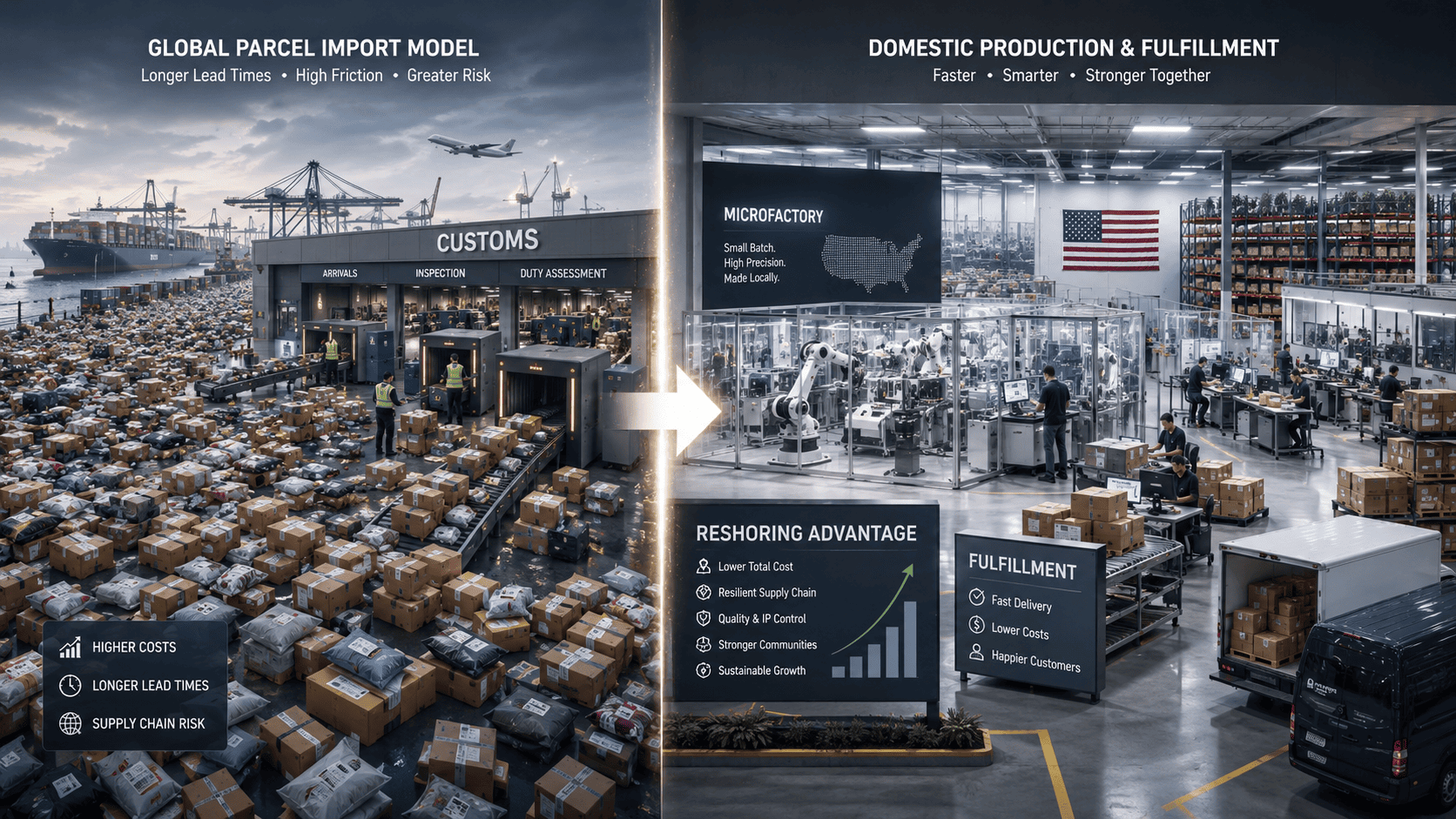
A product can be assembled in the United States, labeled as domestically manufactured, and still depend on a critical component whose raw-material origin cannot be identified.
That distinction is becoming commercially consequential.
On July 20, 2026, the White House issued Executive Order 14415, directing tighter domestic and allied sourcing of critical materials and components used in national-security supply chains. Beginning January 1, 2027, covered-material waivers are to become substantially more restrictive. Contractors seeking continued waivers will need formal mitigation plans identifying noncompliant sources, documenting efforts to obtain compliant materials, and establishing timelines for removing those materials from their supply chains.
The order goes considerably deeper than conventional country-of-origin documentation.
It directs the development of requirements for prime contractors and subcontractors at every tier to trace critical supply chains from raw materials through end products. Contractors may be required to provide an “indentured” bill of materials covering components, parts, equipment, software, materials, and raw-material origin. They will also need written supplier-vetting procedures, risk notifications, corrective-action plans, and evidence that alternative domestic or allied sources are being qualified. Failure to qualify an available alternative could affect task orders, contract options, or the underlying contract itself.
Rare-earth permanent magnets illustrate why this matters.
Neodymium-iron-boron magnets are embedded in technologies ranging from robotics and transportation to aerospace, defense systems, advanced semiconductor fabrication, electrification, and data-center equipment. Yet the vulnerability is often buried several tiers below the manufacturer purchasing the finished motor, actuator, pump, sensor, or control system.
The United States is now adding domestic capacity. MP Materials began manufacturing NdFeB permanent magnets at its Fort Worth operation in December 2025. In February 2026, the company selected Northlake, Texas, for its planned “10X” magnet campus and said the project would help bring its expected total U.S. capacity to approximately 10,000 metric tons annually when commissioning begins in 2028. Those are substantial developments, but they do not make qualified domestic supply immediately available across every specification, volume, geometry, coating, application, and customer program.
USGS reported in 2026 that China remained a major source for 14 of the 33 critical minerals on which the United States is most import-dependent. The exposure is therefore broader than magnets alone. It reaches alloys, electronics, batteries, optical materials, industrial chemicals, machine tools, aerospace systems, and many of the components required to automate a reshored factory.
What manufacturers should do now
Manufacturers should identify every product family containing a critical material, not merely the components purchased directly. Procurement teams should require tier-one suppliers to disclose relevant sub-tier producers, processing locations, ownership risks, material origin, and alternative-source status.
Engineering teams should begin qualifying alternates before a supply interruption or contract requirement makes qualification urgent. A supplier appearing on an approved list does not mean its material is interchangeable without testing, process validation, quality review, and possible product redesign.
Companies should also distinguish between domestic manufacturing and domestic material independence. A motor assembled in the United States with an imported magnet may improve lead time without eliminating geopolitical exposure. A domestically produced magnet made from inadequately traced feedstock may solve only part of the problem.
Recycling deserves a formal place in the strategy. Production scrap, obsolete motors, hard drives, industrial equipment, and returned products can become recoverable material streams rather than waste. Closed-loop systems will not replace mining and processing, but they can reduce exposure, stabilize selected material flows, and create a secondary domestic source.
The next reshoring audit will not stop at the factory door. It will continue through the bill of materials, through every supplier tier, and ultimately to the origin of the material itself.A company that cannot trace the magnet may not truly control the machine.