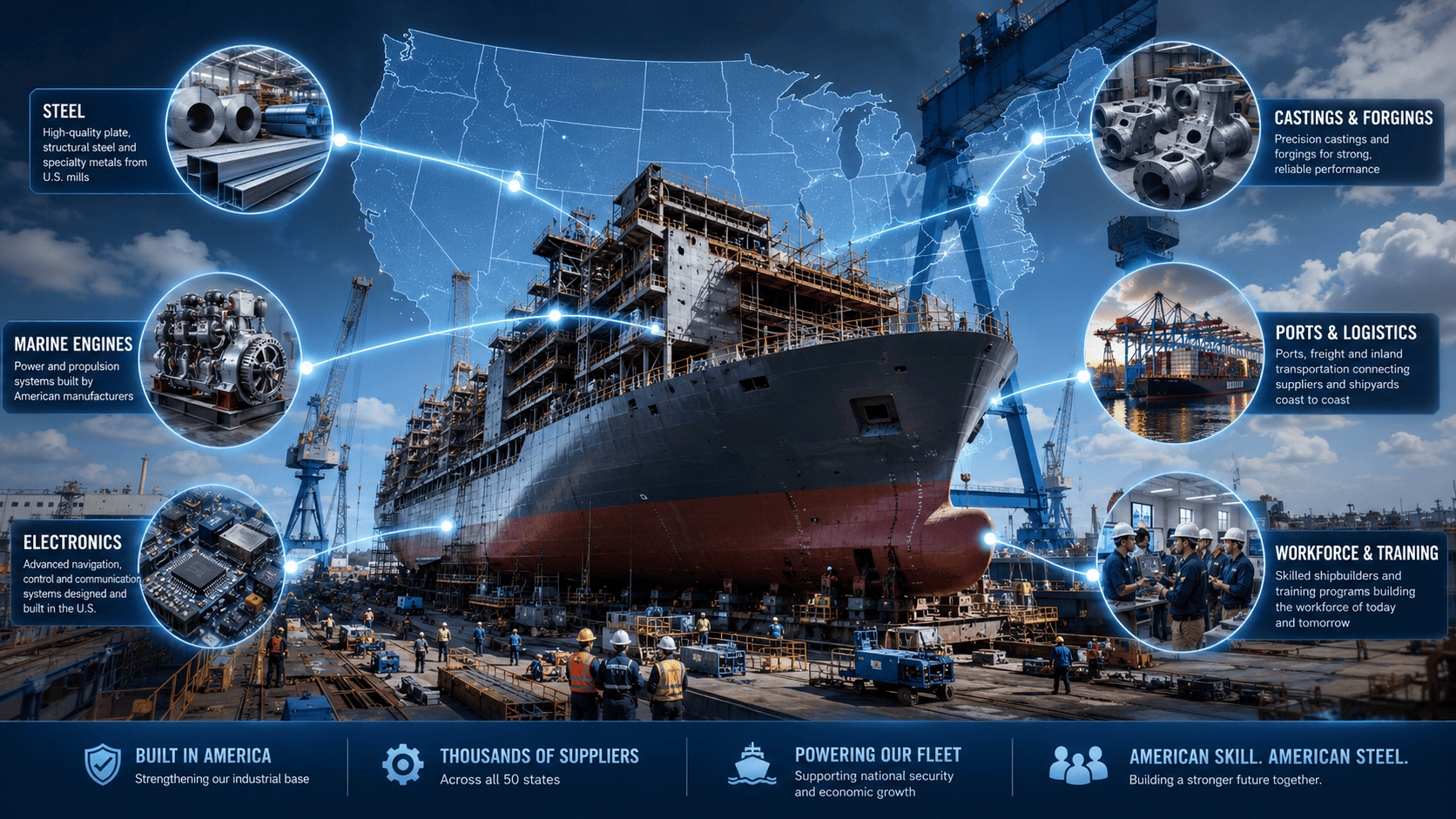
Suggested hero image: A large commercial vessel under construction, surrounded by an illustrated network of U.S. steel, engine, electronics, casting, port, and workforce suppliers.
A shipyard is not one factory.
It is the final assembly point for an industrial system extending across steel mills, foundries, forges, engine producers, electrical manufacturers, automation companies, coating suppliers, software firms, ports, training institutions, and thousands of specialized component producers.
That makes shipbuilding one of the clearest tests of whether the United States can reshore an entire production ecosystem rather than a highly visible final assembly operation.
The White House’s February 2026 America’s Maritime Action Plan states that less than 1% of new commercial ships are built in the United States. It describes a domestic base of 66 shipyards: eight active shipbuilding yards, 11 additional yards with build positions, 22 repair yards with drydocking, and 25 topside repair yards. The plan argues that current capacity is insufficient to scale at the rate required for national priorities.
The plan is structured around rebuilding shipbuilding capacity, reforming maritime education and training, protecting the maritime industrial base, and strengthening national-security and industrial resilience. It also identifies stop-start federal purchasing, labor shortages, high capital requirements, concentrated suppliers, and critical components available from only one source as impediments to scale.
The opportunity extends far beyond coastal shipyards
The plan specifically calls for greater domestic capacity in large marine engines, reduction gears, propulsion shafts, propellers, forgings, castings, high-strength steels, and advanced electronics. It recommends supplier-development investments, vendor-qualification support, secondary sourcing, shorter qualification cycles, and demand commitments capable of supporting private investment.
That creates an opening for manufacturers that may not identify themselves as maritime companies.
A producer already serving heavy equipment, rail, power generation, aerospace, oil and gas, industrial automation, or defense may possess relevant machining, welding, casting, electrical, control-system, testing, or materials capabilities. The barrier is frequently not basic manufacturing ability. It is marine qualification, approved-vendor status, technical documentation, cybersecurity requirements, quality assurance, production traceability, and confidence that demand will last long enough to justify the investment.
Manufacturers should begin by mapping current capabilities against the critical-component categories identified in the Maritime Action Plan. They should determine which shipyards, vessel operators, prime contractors, and government programs control qualification and purchasing.
A supplier waiting for a direct ship contract may wait too long. The nearer opportunity may be a qualified component, repair capability, replacement part, digital engineering service, testing operation, or secondary source for an existing sole-source item.
Federal support is beginning, but execution remains the test
For fiscal year 2026, the Maritime Administration made $35 million available through its Small Shipyard Grant Program. Eligible grants can support capital improvements and workforce training, generally covering up to 75% of an approved project’s cost at facilities with fewer than 1,200 production employees. The program expressly emphasizes efficiency, competitive operations, technology, repair, construction, and workforce productivity.
The Maritime Action Plan also proposes the creation of up to 100 Maritime Prosperity Zones, each potentially designated for ten years. The proposal would extend eligibility beyond traditional coastal centers to maritime suppliers, workforce institutions, advanced manufacturers, river regions, Great Lakes communities, Alaska, Hawaii, U.S. territories, and Gulf and coastal locations. These remain proposed policy actions rather than completed designations, but they reveal how broadly the administration defines the industrial base.
Not every maritime trade instrument is settled. USTR suspended the Section 301 maritime, logistics, and shipbuilding action for one year, from November 10, 2025, through November 9, 2026. Companies should therefore distinguish between durable needs—replacement capacity, supplier redundancy, repair readiness, skilled labor, national-security demand—and trade measures that can be modified or paused.
Demand continuity will determine whether the strategy works
Shipbuilding cannot scale efficiently through occasional announcements and one-off vessel orders.
Suppliers need multiyear demand visibility before financing dedicated tooling, larger facilities, specialized equipment, technical personnel, certification programs, and inventory. Shipyards need repeatable designs and production learning rather than constant customization. Training institutions need credible hiring forecasts before expanding programs. Communities need evidence of continuing industrial activity before building infrastructure around a single award.
The Maritime Action Plan itself calls for predictable, multiyear demand signals that support investment in yards and suppliers. That may prove more important than any individual grant.
Shipbuilding is reshoring at system scale because the vessel is only the visible product.
The real industrial contest is everything behind it: every casting, cable, motor, control, weld, software module, technician, repair facility, and qualified second source required to deliver the ship repeatedly, affordably, and on schedule.
Rebuilding the yard will make headlines.Rebuilding the supplier base will determine whether the ships are actually built.