For years, one of the strongest offshore advantages was not factory labor.
It was the parcel.
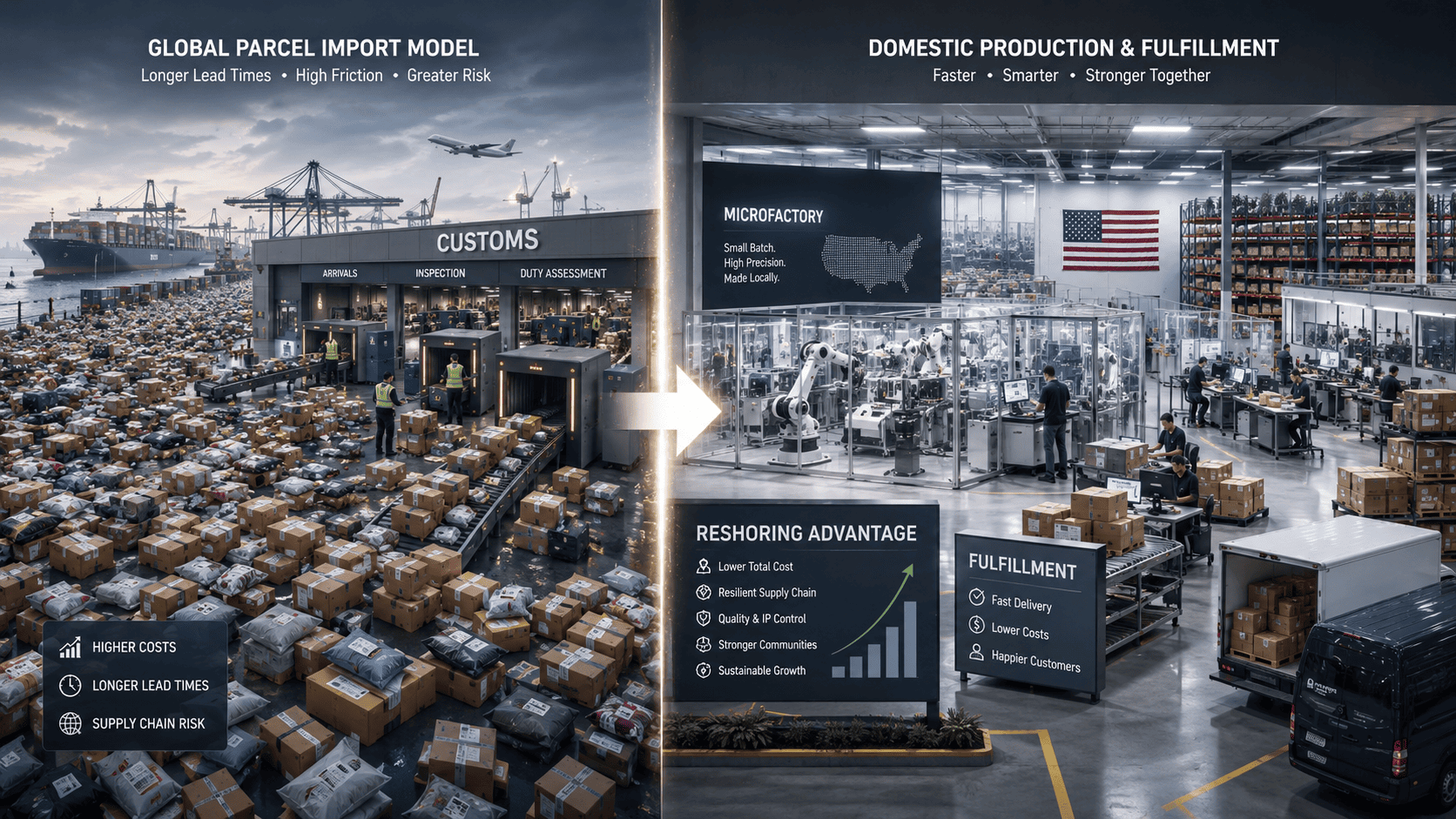
Digital sellers could manufacture abroad, hold inventory near the overseas factory, and send individual low-value orders directly to American consumers. That model reduced the need for U.S. inventory, consolidated customs entries, domestic warehouses, and traditional wholesale distribution.
Its economics have changed.
The United States suspended duty-free de minimis treatment globally in 2025. On February 20, 2026, the administration continued that suspension for shipments regardless of value, country of origin, transportation mode, or entry method, including shipments traveling through the international postal network. Nonpostal shipments that previously qualified must now use an appropriate customs entry and are subject to applicable duties, taxes, fees, and other charges.
The scale of the former channel was enormous. White House data citing U.S. customs activity reported that de minimis shipment volume increased from 134 million packages in 2015 to more than 1.36 billion in 2024—more than four million packages processed on an average day. The 2025 tax legislation also permanently repeals the statutory basis for the worldwide exemption effective July 1, 2027, making the structural direction clearer even if individual duty rules continue to change.
This does not mean billions of products will immediately be manufactured in the United States.
It means the cost comparison must be rebuilt.
The old landed-cost model is incomplete
A direct-to-consumer importer must now evaluate duties, customs-entry costs, data requirements, carrier charges, possible inspection delays, valuation controls, tariff classification, origin documentation, returns, and the working capital tied to each operating model.
For some products, offshore manufacturing will remain clearly less expensive. High-volume, standardized goods with low duty exposure and limited return rates may still support overseas production followed by bulk importation.
Other categories deserve a new analysis. Products with high customization, volatile demand, frequent design changes, expensive returns, short selling seasons, uncertain tariff treatment, or a large number of slow-moving SKUs may benefit from postponing production until demand is visible.
That is where small-batch reshoring becomes relevant.
A domestic operation does not need to reproduce an entire offshore factory to change the economics. It may perform final assembly, configuration, printing, finishing, programming, packaging, kitting, testing, personalization, repair, or refurbishment. Core components can still be imported in commercial quantities while customer-specific work is completed closer to demand.
This hybrid structure can reduce finished-goods inventory and protect the company from committing to thousands of completed units before it knows which configuration will sell.
Recalculate by SKU, not by container
Companies should divide their catalog according to duty exposure, unit weight, freight cost, order frequency, product variability, return rate, customer-service burden, and required delivery time.
The relevant question is not whether “domestic manufacturing” is less expensive across the entire catalog. It is which SKUs, production steps, and order profiles become more competitive when the parcel loophole is removed.
A disciplined review should include:
- Full duty and customs-entry expense.
- Brokerage and carrier-administration charges.
- Inventory carrying cost in each model.
- Returns, repair, refurbishment, and disposal.
- Markdown risk on imported finished goods.
- Lost sales caused by long replenishment cycles.
- The value of rapid product changes and replenishment.
- Domestic labor and automation required for the delayed production step.
Supplier contracts also need attention. Importers should know who controls classification, valuation, origin data, entry filings, and importer-of-record responsibilities. Delivery terms that appeared efficient when parcels entered duty-free may allocate cost and compliance risk very differently under the new structure.
A new opening for microfactories
The end of de minimis may strengthen the business case for smaller, digitally managed production cells located near fulfillment operations rather than large replicas of overseas plants.
These facilities can serve as launch factories for new products, low-volume spare-parts operations, customization centers, repair depots, and surge-capacity sites. Automation, additive manufacturing, digital work instructions, and modular equipment can make low-volume domestic operations more viable without promising mass employment.
The policy change will not restore every industry that left the United States.
It may do something more immediate: make the first profitable thousand units easier to produce near the American customer.For many companies, that is where reshoring actually begins.