Reshoring tax models have traditionally concentrated on machinery, research credits, payroll incentives, property-tax abatements, training grants, and state economic-development packages.
The factory building itself now requires considerably more attention.
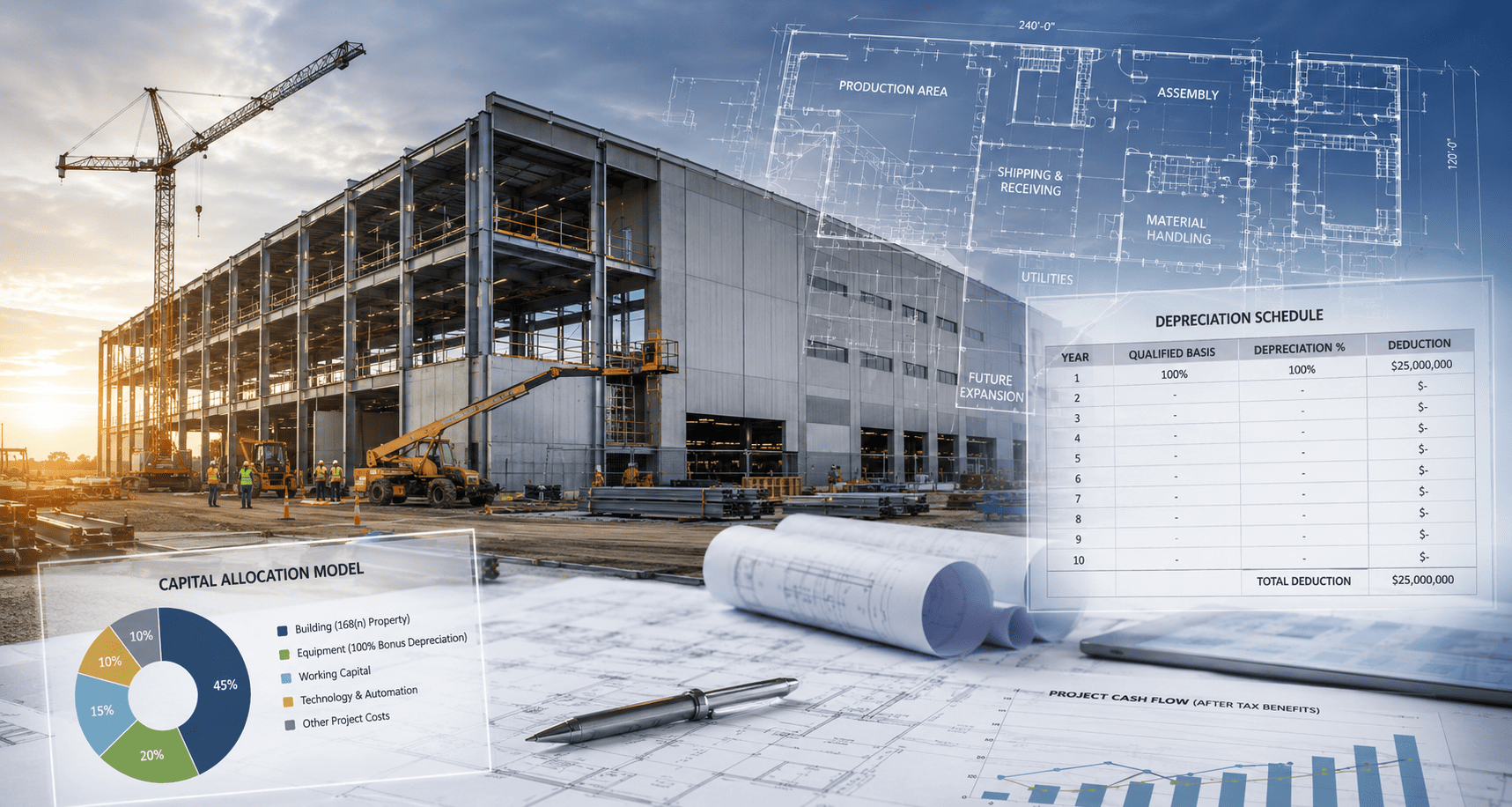
Section 168(n) of the Internal Revenue Code created an elective special depreciation allowance for qualified production property. Under interim guidance issued by the Treasury Department and IRS in February 2026, a taxpayer may designate up to 100% of the eligible depreciable basis of qualifying nonresidential real property for the special allowance. The building or eligible portion must be used as an integral part of a qualifying production activity.
The provision generally covers property used in manufacturing, production, refining, chemical production, or agricultural production where the activity substantially transforms tangible property. Construction must begin after January 19, 2025, and before January 1, 2029. The property must be placed in service in the United States or a U.S. territory after July 4, 2025, and before January 1, 2031. Certain acquired properties may also qualify under specific conditions.
This is not a blanket deduction for everything inside the project boundary.
Only qualifying production space is eligible. Offices, general research areas, finished-goods storage, and portions used for other nonqualifying activities are generally excluded. When only part of a building supports the qualifying production activity, the eligible basis may be lower than the basis of the entire facility. Property that must be depreciated under the Alternative Depreciation System is also excluded.
The election also carries long-term operating consequences. It must be made with a statement attached to the timely filed return for the year in which the property is placed in service and generally cannot be revoked except under extraordinary circumstances. If the property ceases to be used as an integral part of a qualified production activity within ten calendar years, the taxpayer may be required to recapture the allowance as ordinary income.
This changes project planning before construction begins
The tax function can no longer arrive at the end of the project and reconstruct the production footprint from invoices.
Eligibility may depend on when construction began, when the asset became ready and available for its intended use, which spaces directly support production, how shared building systems are allocated, and how the company documents the use of each portion of the facility.
Tax, engineering, construction, real estate, operations, and finance teams should therefore agree on the qualifying production boundary while the plant is still being designed.
Process-flow diagrams, floor plans, construction contracts, change orders, equipment layouts, utility systems, commissioning records, occupancy documentation, and placed-in-service evidence should be retained as part of the tax file. The project’s accounting structure should make eligible and ineligible costs distinguishable rather than combining them in one undifferentiated building account.
The new building provision also sits alongside separate federal guidance restoring 100% additional first-year depreciation for certain eligible equipment acquired after January 19, 2025. A reshoring project may therefore have one tax analysis for production real property and another for machinery, controls, material-handling equipment, robotics, computers, and other qualifying personal property.
The deduction improves timing, not operating performance
Accelerated depreciation can strengthen early project cash flow by moving deductions forward. It can lower the amount of external financing required, improve the after-tax net present value, and make the commissioning date financially significant.
It does not fix a facility with weak demand, poor labor availability, excessive utility costs, inadequate suppliers, or an unrealistic production ramp.
Companies should show the tax benefit separately from the plant’s underlying operating case. Otherwise, a temporary cash-tax advantage can obscure a permanently uncompetitive cost structure.
The strongest reshoring model will answer four questions clearly:
- What portion of the facility is likely to qualify?
- What documentation supports the construction and placed-in-service dates?
- What operating changes could create recapture exposure?
- Does the project remain economically sound without the accelerated deduction?
Section 168(n) is not merely a tax-department issue. It is now a site-selection, facility-design, construction-timing, and capital-allocation issue.
The companies that document it early will have options. Those that examine it after commissioning may discover that an important benefit was designed out of the project before anyone recognized it.Tax eligibility depends on each taxpayer’s facts and should be evaluated with qualified tax counsel and accounting advisers.